Blog

The Saint Who Refused to Divide His Life

Some of us run two lives.  There is the spiritual life—prayer, Mass, the quiet moments when we turn toward God. And there is the working life—the meetings, the invoices, the services, and the problems or challenges they create. We call it compartmentalization. It keeps both practices divided—faith goes here; work goes there. Recently, the Church celebrated the feast of Saint Benedict of Nursia, who refused to divide them. A Rule Born in the Ruins Benedict was born around the year 480, as the Roman world was collapsing around him. Sent to study in Rome, he saw the moral rot of the city up close and walked away from it, seeking God in solitude at Subiaco. In time, he founded the monastery of Monte Cassino and wrote a short guide for the life he had found there, called the Rule of St. Benedict. His aim was modest: to order a single day around God. Yet the practices of that small project are still used today. For fifteen centuries, his Rule has been forming lives, and its central insight is one we can all benefit from. Ora et Labora The spirit of Benedict’s Rule is captured in three Latin words: ora et labora—pray and work. He refused to treat them as rivals competing for the same hours within a day. Prayer and work were two halves of one life offered to God, woven together in a daily rhythm: time to pray, time to labor, time to rest, and then to begin again. For Benedict, the labor itself was holy—the hours at the workbench, the field, and the ledger were a way of seeking God, as long as each was done for Him. St. Paul had said it plainly: “Whatever you do, do from the heart, as for the Lord and not for

Hire for Character

You can teach almost anyone your software, your process, your product line. What you can’t teach—at least not quickly, and not in an onboarding week—is whether a person will tell you the truth when it costs them something.  Every owner who has made a bad hire knows the resume looked fine and the interview went well. It was what was underneath that didn’t hold up. That’s character—how someone shows up in collaboration, conflict, and deliverables, and how they represent your company to your team and your customers.  Skills Are Visible. Character Isn’t. The things easiest to measure are usually the things easiest to fix. Experience, credentials, technical know-how—all of it can be taught to a willing learner. But the things hardest to measure—integrity, humility, diligence, the instinct to own a mistake—are exactly the things you can’t.  Charm interviews well. Character shows up in stories. Instead of asking what someone would do in a hypothetical, ask what they have already done. “Tell me about a time you were wrong about something important.” “Tell me about a decision you disagreed with, and how you handled it.” Then listen for the pronouns. People of character tend to say “I” when describing failure and “we” when describing success. Those still learning often reverse the two. And when you check references, check for character on purpose. Don’t just ask whether someone was good at the job. Ask whether they’d hire the person again, and why—then wait through the pause. Character Is a Habit St. Thomas Aquinas, the great medieval teacher, described virtue as a habit—a stable disposition formed by doing the right thing so many times it becomes second nature. That’s a practical hiring insight. You’re not looking for someone who feels honest in the interview. You’re looking for someone who has practiced honesty, patience,

Making Decisions

Every business owner has a decision they keep circling. A hire. A big contract. A pivot. Letting someone go. You’ve built the pro-and-con list twice. You’ve run the numbers, slept on it, and run them again. And the data has told you everything it’s going to tell you—and it still isn’t enough to make you sure. A good decision isn’t the one that turns out perfectly. It’s the one you made well with what was in front of you. So if certainty isn’t coming, it helps to have a process you can trust instead. A Saint Who Understood Hard Decisions St. Ignatius of Loyola spent his life studying how people make decisions. Before he was a saint, he was a soldier recovering from a battlefield injury, forced to sit with his own thoughts for months. What he noticed became the foundation for how he taught others to discern. One of his central warnings: don’t make a major decision while you’re in desolation—that state of inner turmoil, anxiety, or darkness. When you’re anxious, drained, or spiraling, your judgment is running on fumes. Desolation clouds clarity. It convinces you to move when you should wait, or to freeze when you should act. Notice your interior peace before you commit. If the only thing pushing you toward a choice is panic, wait for the panic to clear, then look again. The Framework Once you’re steady, Ignatius offers a simple three-part process. At its core, this framework is about letting go—trusting that there’s a process, that God is part of it, and that your community is part of it too. You’ll still plan, and you should—planning is good stewardship. But hold the plan with an open hand, so you can lean on Christ and fellowship to carry you through. “The human heart plans the

Built on Two Men Who Failed

Yesterday, the Church celebrated the Feast of Saints Peter and Paul—two men who, by any ordinary measure of leadership, should never have gotten the job. Peter denied knowing Jesus three times on the worst night of His life. Paul didn’t merely doubt the early Church—he hunted it: “I persecuted the Church of God beyond measure and tried to destroy it” (Gal 1:13). If you were assembling a founding team for something meant to last two thousand years, neither resume makes the cut. And yet these are the two God chose. He Commissions on the Far Side of Failure After the Resurrection, Jesus didn’t quietly reassign Peter. He publicly asked three times, “Do you love me?”—once for each denial—and giving him the same charge each time: “Feed my sheep” (Jn 21:17). The failure became the seed from which his commission grew. If you’re carrying a decision you regret—a person you handled badly, a season you’re not proud of—Peter is proof that God does not disqualify people based on their worst moment. The question Jesus asked wasn’t “Can you explain what happened?” It was “Do you love me?” If your heart is oriented toward Him, you are not disqualified. You may, in fact, be more ready than you were before. He Builds with People Who Are Nothing Alike Peter was a fisherman—unschooled, impulsive, fiercely loyal. Paul was a Roman citizen. The two clashed openly at Antioch (Gal 2:11). And yet together they built something neither could have built alone: Peter gave the early Church its pastoral anchor; Paul gave it its reach. You know the pull to hire in your own image—people who think like you and agree easily. But Peter and Paul are a reminder that enduring work is often built by people who would never have chosen each other and

Whose Name Is on the Door?

Your name—or the name you chose for it—is on the door, the invoices, the building you walked into this morning. You built this. And this week, the Church celebrates a man who spent his entire life making sure his name wasn’t the one people remembered. On Wednesday, June 24, we mark the Nativity of St. John the Baptist—one of only three births the Church celebrates all year, along with those of Jesus and His mother, Mary. That alone should make us lean in. When the neighbors assumed the newborn would carry his father Zechariah’s name, Elizabeth refused: “He will be called John (Lk 1:60).” It was the name God had chosen before the child was ever conceived.  A Life Spent Pointing Past Himself John grew up to gain everything many leaders today desire. A crowd. Influence. A movement with his name on it. And he spent all of it directing people away from himself: “I am not the Messiah… there is one among you…the one who is coming after me, whose sandal strap I am not worthy to untie (Jn 1:20-27).” He summarized his own mission in six words—”He must increase; I must decrease (Jn 3:30).” For a business owner, that’s a harder sentence than it first appears. You poured years into building something that carries your name. The desire to be recognized for it isn’t vanity; it’s human. But John points to a different kind of ambition—to build something so well that what people ultimately encounter through it is Christ, not you. Most of It Happens Where No One Is Watching Scripture tells us almost nothing about John’s early years except this: he “grew and became strong in spirit, and he was in the desert until the day (Lk 1:80)” he stepped into public view. Years of hidden formation.

The Business You Keep Comparing Yours To

There’s a business you check on more often than you’d like to admit. Maybe it’s a competitor across town. Maybe it’s a former colleague’s company, or a name that keeps showing up in your feed with another win. You tell yourself you’re just staying informed. But somewhere underneath, you’re keeping score. Every business owner does it. Comparison can feel like ambition—the thing that keeps you sharp and moving. But left unchecked, it quietly trades your peace for someone else’s highlight reel. For a Catholic business owner, comparison carries a particular danger. It doesn’t just make you anxious. It lifts your eyes off the specific work God entrusted to you and fixes them on the work He entrusted to someone else. Comparison Lies About Two Things First, it lies about them. You’re measuring your behind-the-scenes—the cash-flow gap, the conversation you’re dreading, the doubt that wakes you at 3 a.m.—against their public-facing best. That was never a fair comparison, and it was never meant to be one. Second, it lies about you. It whispers that your worth is relative—that you’re only doing well if you’re doing better than someone else. But your business has a vocation that belongs to no one else: a particular set of people to serve, a particular community to bless, a particular witness only you can give. None of that appears on anyone else’s scoreboard. The Antidote Is Gratitude. The goal isn’t to care less about excellence. It’s to anchor your ambition in something steadier than the company down the street. Scripture is blunt about jealousy—it “rots the bones (Prov 14:30).” St. John Chrysostom, an early Church Father, taught that actively practicing gratitude is the most direct way to conquer jealousy. He encouraged believers to thank God not only for their own personal blessings but also for the

The Standing Meeting That Changes Everything

The Standing Meeting That Changes Everything Everything gets scheduled as a business owner—client calls, team check-ins, and the quarterly review that’s been on your calendar for a month. Your day is built around the meetings that matter. But the most important appointment asks nothing about your bottom line and gives back more than any other—time spent with Christ. This week’s Gospel (June 17) invites us to slow down and receive something we can easily overlook in a results-driven world — the gift of intimate time with the Lord. For a business owner committed to placing God at the center of your work and life, this isn’t just a spiritual discipline; it’s a deepening of a relationship. We don’t carve out that time for public recognition or applause. We do it because we genuinely want to know Him—to draw closer to His merciful and loving heart. That time of prayer belongs to Him. And what more fitting way to profess your love for Christ than to offer Him a portion of each day, not out of obligation, but out of longing? You May Already Have a Standing Meeting For many of you, that daily offering has already begun. Each morning, His Way At Work sends out free Daily Reflections—a short passage of Scripture and a brief meditation you can pray through before the inbox takes over. If you’re already using them, then you’ve made time with Christ a standing appointment, and that habit is no small thing. It reorders the day around the One who matters most, before the noise begins.And if you’re not receiving them yet—or you’ve fallen out of the rhythm somewhere along the way—consider this your invitation. Let our Daily Reflections be the first standing meeting on tomorrow’s calendar. → Subscribe to our free Daily Reflections here Step

blog hero clinic

More Than a Clinic

When Judith Beck, ARNP, opened her health practice in Kansas, she had a vision that went far beyond appointment slots and prescription pads. Her goal was to make healthcare genuinely affordable and to reach patients at levels no insurance plan ever covers. What she may not have fully anticipated was the moment that vision would receive a formal, sacred name. Beck recently consecrated her practice to the Sacred Heart of Jesus—joining our growing movement of Catholic business owners who are bringing their work formally under the mantle of faith. While her story began as a quiet conviction, it grew into the sacred commitment she professed aloud with her team and patients. Beck heard about the opportunity through a priest in the Archdiocese of Kansas City, Kansas. She ordered a Consecration Kit, gathered her team—many of whom are not Catholic—and together they prepared for the celebration. Following a Mass at the practice, the consecration took place in an atmosphere she describes as full of joy and acceptance. Beck shared that the consecration was not a change in direction, but a formalization of what her practice had always been. And “hopefully, the Sacred Heart of Jesus will work through us more and more.”— Judith Beck, ARNP Healthcare That Goes the Extra Mile Beck’s practice has never operated in a purely clinical mode. Beyond treating illness and caring for the community’s physical needs, her team connects patients with job opportunities. The mission of the practice is to care for the whole self, including emotional and spiritual health, for its patients.  In that sense, the consecration was a natural fit—the Sacred Heart of Jesus represents a love that is total, self-giving, and attentive to the suffering of the whole person. It is a fitting patron for a practice that has always tried to do

blog hero sacred hear2t

Through the Sacred Heart

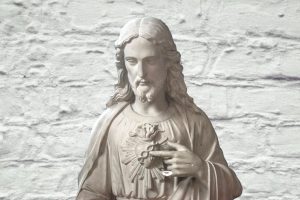
The Sacred Heart of Jesus is the symbol of God’s boundless, merciful love for every one of us. His Heart, wounded and open, is an invitation: Bring me your work, your company, and your worries. Devotion to the Sacred Heart of Jesus began in the eleventh and twelfth centuries but grew in prominence through our Lord’s private revelations to St. Margaret Mary Alacoque in seventeenth-century France. St. Margaret Mary received several visions of Christ, who revealed His Heart as the sign of His infinite love for humanity and His longing for us to return that love through devotion and prayer. For centuries, Catholics have consecrated homes, families, nations, and lives to the Sacred Heart. But there is a growing movement—one you are part of—of business owners consecrating their companies to Jesus. This act of consecration is not a ritual that changes the logo on your door. It is a declaration of stewardship. It says: I did not build this alone. I do not lead this alone. And I will not carry this alone. It’s a recognition that your gifts, business, and community are entrusted to you by God—and you are called to steward them for eternal impact. The Sacred Heart of Jesus proclaims that God cares for each of us and desires to transform our hearts. But God does not take away our freedom, and there is no love without freedom. You cannot force someone to love you. God loves us freely, and we are called to love Him freely in return. Devotion to the Sacred Heart of Jesus teaches us to collaborate with His grace and mercy. What I do—or not—matters.  What does this look like in business? When God’s love is woven into the fabric of a company, it shows. It shapes how decisions are made, how people

blog hero the gift of work

The Gift of Work

“The Lord is my light and salvation.” In Matthew’s Gospel (Matthew 9:27-31), Jesus restores the sight of a blind man. In some way, we are all blind. We have blind spots. We need the light of faith. We need salvation.  A business owner once spoke to me about the importance of reading C.S. Lewis’ Space Trilogy. There, he describes a planet where people have a much clearer, more penetrating vision and awareness of spiritual realities. We on earth, in contrast, are more often than not blind to spiritual realities and in many cases totally in denial of their existence. We need God’s gift of spiritual sight. How often have we heard people say that they don’t get anything out of Mass? My response is: “But what do you bring to Mass?” We are called to bring our work and ultimately our very selves to Mass so to worship God through, with, and in Christ!  You are the only one who can give yourself to God. Worship means giving myself to God each and every day. “But I give myself to my work every day!” That’s good, but how do you offer your work to God? I like to ask young people, “What are the only essential elements without which I cannot celebrate Mass? The bread and wine! The rest we can work out. But without the bread and wine that you must provide, we have no Mass.  Where do the bread and wine come from? “Fruit of the earth and work of human hands”; ‘Fruit of the vine and work of human hands.” These are gifts from God that have been perfected, more fully developed by man’s work.  The Catechism reminds us that God did not create the world in a finished, perfect state. Creation was deliberately left unfinished so

What’s Your Reputation?

Whether you’ve been on this journey for years or are renewing your focus, uniting your company’s culture with Christ is one of the most meaningful commitments a business owner can make. But in the pursuit of that mission, it’s easy to become so focused inward—on your mission statement, your core values, your team culture—that you’ve been less intentional about what the world just outside your doors actually thinks of you. Reputation tends to be reactive territory. We pay attention to it when something goes wrong. But by then, it’s already been decided. Your reputation lives in how your team treats a vendor who’s running late. Whether you show up personally to a community event or send someone in your place. How your company responds when no one important is watching. Reputations are assembled in the quiet, ordinary interactions your business has with the world around it, and at some point, that assembly becomes the story people tell about you. One of the most desirable outcomes of a Christ-centered company is the eternal impact it makes: how it improves the work and lives of others, how it extends His love in simple gestures, and how it makes Him known in the world beyond Sunday Mass. If these are your intentions, then the reputation your community holds of you truly matters. Be Intentional Take a moment to reflect on your core values. If you don’t have formal core values, consider three words that represent your company culture. Write them down. Now consider the three words your community would use to describe your company: your vendors, your customers, and your neighbors. Is there a gap between those two lists? It might reveal that your values are lived loudly inside your walls but quietly outside them. It might indicate that your external presence hasn’t

summit hero final

Work as a Mission

His Way At Work U.S. SummitOctober 8–9, 2026  •  Kansas City, KS What if your business wasn’t just a business — but a ministry? What if the daily grind of running a company could carry eternal weight? These aren’t rhetorical questions. They’re the ones that keep many business owners longing for something more. If you’ve ever sensed that your work was made for a purpose bigger than profit, you’re not alone. And there’s a gathering being built for people exactly like you. The His Way At Work U.S. Summit is coming to Kansas City on October 8–9, 2026—and this year’s theme is Work as a Mission. Why People Show Up Business owners attend summits for many reasons. The sessions. The speakers. The chance to step away from the day-to-day and think bigger. But if you ask most people what they remember most, it’s rarely a slide deck. It’s the conversation over coffee with someone who’s wrestled with the same questions you have. It’s realizing you’re not the only one trying to figure out how faith and leadership actually fit together in practice. It’s leaving with a handful of relationships that don’t end when the event does. That’s what this summit is built for. Stories Worth Hearing You’ll hear from business owners who have run their companies as ministries, and they won’t be giving you the highlight reel. They’ll talk about the failures. The seasons where the mission felt like a nice idea, but the bottom line kept overriding. The moments of doubt. And what changed for them. That kind of honesty has a way of reaching something in you that a polished keynote can’t. It opens the door to ask your own hard questions and maybe start answering them differently. Something to Carry Home Alongside the stories, you’ll receive real

tough decision blog

How to Make Tough Business Decisions Without Losing Sleep — Or Your Soul

Every business owner knows the feeling. It’s 3 am, and your mind is racing—running through the same decision on a loop. Do you let someone go who isn’t performing but has been loyal for years? Do you walk away from a client who pays well but costs you your peace? Do you take the contract that stretches your team to its limits? Do you bring on a partner whose vision doesn’t quite align with yours, but whose resources would solve your immediate problems? Did you make the right or wrong decision today—a form of buyer’s remorse? Tough decisions are the unavoidable tax of leadership. But for Catholic business owners, they carry an extra weight because you know that how you decide matters just as much as what you decide. Most decision frameworks will tell you to weigh the data, model the outcomes, and choose the option with the highest return. But they leave out the two things you care about—the people affected and whether you can stand behind the decision with integrity. Next time you are staring down a decision that won’t leave you alone, united with God in prayer, follow these steps: Step 1: Clarity Before you can make a good decision, you need to define what “good” means in this situation. Most business owners jump straight to options without first defining outcomes. Ask yourself: what does a successful resolution look like—not just financially, but for everyone involved? When you define success broadly, your options sharpen quickly. Step 2: Counsel Warren Buffett once said that it takes 20 years to build a reputation and five minutes to ruin it. One reason leaders make reputation-damaging decisions is that they make them alone. Identify two or three people in your life—not yes-men, but honest voices—who you consult before major decisions. Be

man at work hero

The Hidden Cost of Building a Business

Nobody warns you about this part of owning a business.  You expected the late nights, pressure, and financial risk—but what you didn’t expect was the gradual feeling that your business owns you more than you own it. As a Catholic business owner, there is a good chance you are especially vulnerable to this. Your faith calls you to serve others, to sacrifice, to give generously. Those are genuine virtues. But somewhere along the way, many faith-driven leaders confuse self-sacrifice with self-destruction, and the cost can be devastating. Burnout doesn’t just hurt you. It can quietly dismantle relationships and everything you have built. When you are running on empty, your decisions suffer. Your team feels it before you admit it. Your family immediately knows it and gets whatever is left, which is rarely enough. And the mission you built your business around starts to feel like a burden rather than a calling. The fix is not working less. It is leading with better boundaries and reframing what boundaries actually mean. Boundaries are not selfishness. It is stewardship. You are responsible for managing yourself as a resource. If you wouldn’t run your equipment into the ground without maintenance, why would you do it to yourself?  Here are four boundaries every Catholic business owner needs to protect: Time. Protect your work hours and your family time with the same seriousness you protect client commitments. What gets scheduled gets honored. Financial. Some clients cost more than they pay. Calculate the full cost—emotional energy, team disruption, time—not just the invoice. Saying no to the wrong client is saying yes to the right one. It sounds strange, but sometimes you have to fire a customer. Emotional. Your business is something you do, not something you are. When outcomes become tied to your identity, every setback becomes

mary hero (1)

Give it to Mary

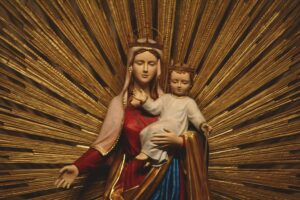
The Church has long entrusted May to the Blessed Virgin Mary, and for good reason. She can be an instrument through whom our imperfect prayers are lifted, purified, and presented to the Heart of her Son. Mary never keeps what she receives. Every grace she carries, she dispenses. Every prayer she intercepts, she beautifies and presents to her Son. This is the deepest mystery of May devotion: Mary leads us always to the Most Sacred Heart of Jesus, the furnace of divine love, the Heart that refuses to be indifferent to our struggles, our sins, our sufferings. To business owners, if you feel the weight of decisions, the tension between profit and principle, the prayers that feel thin by noon, Our Lady invites you: “Bring it to me. All of it.” Bring your ambitions, your fears, even your murkier motivations. She is not shocked. She is a mother. What Mary does with what we bring her is extraordinary – she purifies it, and presents it refined to the Sacred Heart of her Son. You don’t need perfect intentions to start. You need only the humility to say: “Mother, take what I have. Purify it. Present it to Jesus.” To those who have already given their fiat – who consecrated their company and now find it hard – hear this: Your yes is bearing fruit, even when you cannot see it. Mary’s own “fiat” did not protect her from suffering. It led her directly into God’s most perfect plan. And through that yes, the world was saved. Your consecration is not a strategy for comfortable outcomes. It is a participation in that same mystery. Renew your “fiat” today. Especially in the difficult moments and hard days. You walk this road with every soul who has ever trusted Mary enough to place

Bring Faith Into Your Workday — Every Morning

The day’s Gospel and a business reflection delivered each morning — so your work begins with God at the center. Free, every day.