Blog

values hero blog

What to Do When a Client Asks You to Compromise Your Values

It rarely arrives as a dramatic demand. More often, it is a small ask wrapped in a good relationship. Round the numbers down for the proposal. Leave that detail off the report. Look the other way on the thing you both know is not quite right. The client is friendly, the revenue is real, and the line you are being asked to cross is thin enough to step over without anyone noticing. That is exactly what makes the moment so dangerous. Jesus asked the question: “What does it profit a man to gain the whole world and forfeit his soul (Mk 8:36)?” A contract is worth a great deal, but it is never worth forfeiting your soul.  The good news is that most of these moments do not require heroics. They require a plan you decided on before the pressure ever showed up. One thing I have told my employees over and over again is to never run from a problem. A problem can be fixed if it is known. Running away from a problem can breed opportunities for values to be compromised or forfeited.  Name the line before you answer When the ask comes, slow the conversation down. You do not owe anyone an instant yes, and buying yourself a day is almost always available. Get clear on what is actually being requested and whether it crosses a genuine moral line or simply a preference. Some things are matters of style and negotiation. Others touch on honesty, human dignity, or the truth, and those are not on the table, no matter who is asking. Hold the line with grace, not contempt Integrity does not require you to be cold. Assume the client may not even see the problem the way you do, and give them a clean way to


getty images seJUYQU3rZg unsplash

When Honesty Costs You

Being honest is easy—right up until it costs you something. Every business owner knows the moment: the invoice you could round up, and the client would never check. The defect you could ship, because the order would still clear. The missed deadline, you could quietly pin on someone else. The number you could present a little more favorably than it actually is. No one would catch it. It might even help your bottom line. That’s the real test. Not the big, dramatic ethical dilemma—the small, private one where no one’s watching and there’s no upside to telling the truth. What you do there is the truest picture of how you run your business. The Small Test Is the Real Test We like to imagine integrity as a stand you take once, under bright lights. In practice, it’s built in a hundred quiet moments no one will ever hear about: the invoice, the shipment, the report, the answer to a question you’d rather dodge. Jesus put it plainly: “The person who is trustworthy in very small matters is also trustworthy in great ones; and the person who is dishonest in very small matters is also dishonest in great ones” (Lk 16:10). Trust isn’t won in the moments people are watching. It’s won in the ones they’re not. That’s also, practically, what builds a business people come back to. Customers can’t audit your invoices or inspect every shipment. They extend trust because you’ve earned it in the moments they couldn’t see—and they walk the first time they sense you haven’t. Why the Temptation Shows Up Most dishonest decisions aren’t planned. They happen under pressure, in the moment, with no standard in hand to fall back on. That gap—between “I know I should be honest” and “I don’t have a rule for this

stbenedict2

The Saint Who Refused to Divide His Life

Some of us run two lives.  There is the spiritual life—prayer, Mass, the quiet moments when we turn toward God. And there is the working life—the meetings, the invoices, the services, and the problems or challenges they create. We call it compartmentalization. It keeps both practices divided—faith goes here; work goes there. Recently, the Church celebrated the feast of Saint Benedict of Nursia, who refused to divide them. A Rule Born in the Ruins Benedict was born around the year 480, as the Roman world was collapsing around him. Sent to study in Rome, he saw the moral rot of the city up close and walked away from it, seeking God in solitude at Subiaco. In time, he founded the monastery of Monte Cassino and wrote a short guide for the life he had found there, called the Rule of St. Benedict. His aim was modest: to order a single day around God. Yet the practices of that small project are still used today. For fifteen centuries, his Rule has been forming lives, and its central insight is one we can all benefit from. Ora et Labora The spirit of Benedict’s Rule is captured in three Latin words: ora et labora—pray and work. He refused to treat them as rivals competing for the same hours within a day. Prayer and work were two halves of one life offered to God, woven together in a daily rhythm: time to pray, time to labor, time to rest, and then to begin again. For Benedict, the labor itself was holy—the hours at the workbench, the field, and the ledger were a way of seeking God, as long as each was done for Him. St. Paul had said it plainly: “Whatever you do, do from the heart, as for the Lord and not for

mina rad qFSQFSmfZkA unsplash

Hire for Character

You can teach almost anyone your software, your process, your product line. What you can’t teach—at least not quickly, and not in an onboarding week—is whether a person will tell you the truth when it costs them something.  Every owner who has made a bad hire knows the resume looked fine and the interview went well. It was what was underneath that didn’t hold up. That’s character—how someone shows up in collaboration, conflict, and deliverables, and how they represent your company to your team and your customers.  Skills Are Visible. Character Isn’t. The things easiest to measure are usually the things easiest to fix. Experience, credentials, technical know-how—all of it can be taught to a willing learner. But the things hardest to measure—integrity, humility, diligence, the instinct to own a mistake—are exactly the things you can’t.  Charm interviews well. Character shows up in stories. Instead of asking what someone would do in a hypothetical, ask what they have already done. “Tell me about a time you were wrong about something important.” “Tell me about a decision you disagreed with, and how you handled it.” Then listen for the pronouns. People of character tend to say “I” when describing failure and “we” when describing success. Those still learning often reverse the two. And when you check references, check for character on purpose. Don’t just ask whether someone was good at the job. Ask whether they’d hire the person again, and why—then wait through the pause. Character Is a Habit St. Thomas Aquinas, the great medieval teacher, described virtue as a habit—a stable disposition formed by doing the right thing so many times it becomes second nature. That’s a practical hiring insight. You’re not looking for someone who feels honest in the interview. You’re looking for someone who has practiced honesty, patience,

tanya barrow dNyFUQ oaOQ unsplash

Making Decisions

Every business owner has a decision they keep circling. A hire. A big contract. A pivot. Letting someone go. You’ve built the pro-and-con list twice. You’ve run the numbers, slept on it, and run them again. And the data has told you everything it’s going to tell you—and it still isn’t enough to make you sure. A good decision isn’t the one that turns out perfectly. It’s the one you made well with what was in front of you. So if certainty isn’t coming, it helps to have a process you can trust instead. A Saint Who Understood Hard Decisions St. Ignatius of Loyola spent his life studying how people make decisions. Before he was a saint, he was a soldier recovering from a battlefield injury, forced to sit with his own thoughts for months. What he noticed became the foundation for how he taught others to discern. One of his central warnings: don’t make a major decision while you’re in desolation—that state of inner turmoil, anxiety, or darkness. When you’re anxious, drained, or spiraling, your judgment is running on fumes. Desolation clouds clarity. It convinces you to move when you should wait, or to freeze when you should act. Notice your interior peace before you commit. If the only thing pushing you toward a choice is panic, wait for the panic to clear, then look again. The Framework Once you’re steady, Ignatius offers a simple three-part process. At its core, this framework is about letting go—trusting that there’s a process, that God is part of it, and that your community is part of it too. You’ll still plan, and you should—planning is good stewardship. But hold the plan with an open hand, so you can lean on Christ and fellowship to carry you through. “The human heart plans the

agoBANNER 77297922

Built on Two Men Who Failed

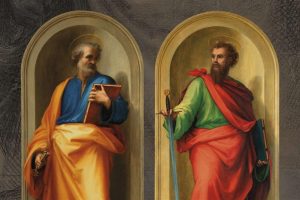
Yesterday, the Church celebrated the Feast of Saints Peter and Paul—two men who, by any ordinary measure of leadership, should never have gotten the job. Peter denied knowing Jesus three times on the worst night of His life. Paul didn’t merely doubt the early Church—he hunted it: “I persecuted the Church of God beyond measure and tried to destroy it” (Gal 1:13). If you were assembling a founding team for something meant to last two thousand years, neither resume makes the cut. And yet these are the two God chose. He Commissions on the Far Side of Failure After the Resurrection, Jesus didn’t quietly reassign Peter. He publicly asked three times, “Do you love me?”—once for each denial—and giving him the same charge each time: “Feed my sheep” (Jn 21:17). The failure became the seed from which his commission grew. If you’re carrying a decision you regret—a person you handled badly, a season you’re not proud of—Peter is proof that God does not disqualify people based on their worst moment. The question Jesus asked wasn’t “Can you explain what happened?” It was “Do you love me?” If your heart is oriented toward Him, you are not disqualified. You may, in fact, be more ready than you were before. He Builds with People Who Are Nothing Alike Peter was a fisherman—unschooled, impulsive, fiercely loyal. Paul was a Roman citizen. The two clashed openly at Antioch (Gal 2:11). And yet together they built something neither could have built alone: Peter gave the early Church its pastoral anchor; Paul gave it its reach. You know the pull to hire in your own image—people who think like you and agree easily. But Peter and Paul are a reminder that enduring work is often built by people who would never have chosen each other and

getty images ZDWZejCVpCM unsplash

Whose Name Is on the Door?

Your name—or the name you chose for it—is on the door, the invoices, the building you walked into this morning. You built this. And this week, the Church celebrates a man who spent his entire life making sure his name wasn’t the one people remembered. On Wednesday, June 24, we mark the Nativity of St. John the Baptist—one of only three births the Church celebrates all year, along with those of Jesus and His mother, Mary. That alone should make us lean in. When the neighbors assumed the newborn would carry his father Zechariah’s name, Elizabeth refused: “He will be called John (Lk 1:60).” It was the name God had chosen before the child was ever conceived.  A Life Spent Pointing Past Himself John grew up to gain everything many leaders today desire. A crowd. Influence. A movement with his name on it. And he spent all of it directing people away from himself: “I am not the Messiah… there is one among you…the one who is coming after me, whose sandal strap I am not worthy to untie (Jn 1:20-27).” He summarized his own mission in six words—”He must increase; I must decrease (Jn 3:30).” For a business owner, that’s a harder sentence than it first appears. You poured years into building something that carries your name. The desire to be recognized for it isn’t vanity; it’s human. But John points to a different kind of ambition—to build something so well that what people ultimately encounter through it is Christ, not you. Most of It Happens Where No One Is Watching Scripture tells us almost nothing about John’s early years except this: he “grew and became strong in spirit, and he was in the desert until the day (Lk 1:80)” he stepped into public view. Years of hidden formation.

vitaly gariev HzF5f sjNyw unsplash

The Business You Keep Comparing Yours To

There’s a business you check on more often than you’d like to admit. Maybe it’s a competitor across town. Maybe it’s a former colleague’s company, or a name that keeps showing up in your feed with another win. You tell yourself you’re just staying informed. But somewhere underneath, you’re keeping score. Every business owner does it. Comparison can feel like ambition—the thing that keeps you sharp and moving. But left unchecked, it quietly trades your peace for someone else’s highlight reel. For a Catholic business owner, comparison carries a particular danger. It doesn’t just make you anxious. It lifts your eyes off the specific work God entrusted to you and fixes them on the work He entrusted to someone else. Comparison Lies About Two Things First, it lies about them. You’re measuring your behind-the-scenes—the cash-flow gap, the conversation you’re dreading, the doubt that wakes you at 3 a.m.—against their public-facing best. That was never a fair comparison, and it was never meant to be one. Second, it lies about you. It whispers that your worth is relative—that you’re only doing well if you’re doing better than someone else. But your business has a vocation that belongs to no one else: a particular set of people to serve, a particular community to bless, a particular witness only you can give. None of that appears on anyone else’s scoreboard. The Antidote Is Gratitude. The goal isn’t to care less about excellence. It’s to anchor your ambition in something steadier than the company down the street. Scripture is blunt about jealousy—it “rots the bones (Prov 14:30).” St. John Chrysostom, an early Church Father, taught that actively practicing gratitude is the most direct way to conquer jealousy. He encouraged believers to thank God not only for their own personal blessings but also for the

curated lifestyle WZC1kaCz1mc unsplash

The Standing Meeting That Changes Everything

The Standing Meeting That Changes Everything Everything gets scheduled as a business owner—client calls, team check-ins, and the quarterly review that’s been on your calendar for a month. Your day is built around the meetings that matter. But the most important appointment asks nothing about your bottom line and gives back more than any other—time spent with Christ. This week’s Gospel (June 17) invites us to slow down and receive something we can easily overlook in a results-driven world — the gift of intimate time with the Lord. For a business owner committed to placing God at the center of your work and life, this isn’t just a spiritual discipline; it’s a deepening of a relationship. We don’t carve out that time for public recognition or applause. We do it because we genuinely want to know Him—to draw closer to His merciful and loving heart. That time of prayer belongs to Him. And what more fitting way to profess your love for Christ than to offer Him a portion of each day, not out of obligation, but out of longing? You May Already Have a Standing Meeting For many of you, that daily offering has already begun. Each morning, His Way At Work sends out free Daily Reflections—a short passage of Scripture and a brief meditation you can pray through before the inbox takes over. If you’re already using them, then you’ve made time with Christ a standing appointment, and that habit is no small thing. It reorders the day around the One who matters most, before the noise begins.And if you’re not receiving them yet—or you’ve fallen out of the rhythm somewhere along the way—consider this your invitation. Let our Daily Reflections be the first standing meeting on tomorrow’s calendar. → Subscribe to our free Daily Reflections here Step

blog hero clinic

More Than a Clinic

When Judith Beck, ARNP, opened her health practice in Kansas, she had a vision that went far beyond appointment slots and prescription pads. Her goal was to make healthcare genuinely affordable and to reach patients at levels no insurance plan ever covers. What she may not have fully anticipated was the moment that vision would receive a formal, sacred name. Beck recently consecrated her practice to the Sacred Heart of Jesus—joining our growing movement of Catholic business owners who are bringing their work formally under the mantle of faith. While her story began as a quiet conviction, it grew into the sacred commitment she professed aloud with her team and patients. Beck heard about the opportunity through a priest in the Archdiocese of Kansas City, Kansas. She ordered a Consecration Kit, gathered her team—many of whom are not Catholic—and together they prepared for the celebration. Following a Mass at the practice, the consecration took place in an atmosphere she describes as full of joy and acceptance. Beck shared that the consecration was not a change in direction, but a formalization of what her practice had always been. And “hopefully, the Sacred Heart of Jesus will work through us more and more.”— Judith Beck, ARNP Healthcare That Goes the Extra Mile Beck’s practice has never operated in a purely clinical mode. Beyond treating illness and caring for the community’s physical needs, her team connects patients with job opportunities. The mission of the practice is to care for the whole self, including emotional and spiritual health, for its patients.  In that sense, the consecration was a natural fit—the Sacred Heart of Jesus represents a love that is total, self-giving, and attentive to the suffering of the whole person. It is a fitting patron for a practice that has always tried to do

blog hero sacred hear2t

Through the Sacred Heart

The Sacred Heart of Jesus is the symbol of God’s boundless, merciful love for every one of us. His Heart, wounded and open, is an invitation: Bring me your work, your company, and your worries. Devotion to the Sacred Heart of Jesus began in the eleventh and twelfth centuries but grew in prominence through our Lord’s private revelations to St. Margaret Mary Alacoque in seventeenth-century France. St. Margaret Mary received several visions of Christ, who revealed His Heart as the sign of His infinite love for humanity and His longing for us to return that love through devotion and prayer. For centuries, Catholics have consecrated homes, families, nations, and lives to the Sacred Heart. But there is a growing movement—one you are part of—of business owners consecrating their companies to Jesus. This act of consecration is not a ritual that changes the logo on your door. It is a declaration of stewardship. It says: I did not build this alone. I do not lead this alone. And I will not carry this alone. It’s a recognition that your gifts, business, and community are entrusted to you by God—and you are called to steward them for eternal impact. The Sacred Heart of Jesus proclaims that God cares for each of us and desires to transform our hearts. But God does not take away our freedom, and there is no love without freedom. You cannot force someone to love you. God loves us freely, and we are called to love Him freely in return. Devotion to the Sacred Heart of Jesus teaches us to collaborate with His grace and mercy. What I do—or not—matters.  What does this look like in business? When God’s love is woven into the fabric of a company, it shows. It shapes how decisions are made, how people

blog hero the gift of work

The Gift of Work

“The Lord is my light and salvation.” In Matthew’s Gospel (Matthew 9:27-31), Jesus restores the sight of a blind man. In some way, we are all blind. We have blind spots. We need the light of faith. We need salvation.  A business owner once spoke to me about the importance of reading C.S. Lewis’ Space Trilogy. There, he describes a planet where people have a much clearer, more penetrating vision and awareness of spiritual realities. We on earth, in contrast, are more often than not blind to spiritual realities and in many cases totally in denial of their existence. We need God’s gift of spiritual sight. How often have we heard people say that they don’t get anything out of Mass? My response is: “But what do you bring to Mass?” We are called to bring our work and ultimately our very selves to Mass so to worship God through, with, and in Christ!  You are the only one who can give yourself to God. Worship means giving myself to God each and every day. “But I give myself to my work every day!” That’s good, but how do you offer your work to God? I like to ask young people, “What are the only essential elements without which I cannot celebrate Mass? The bread and wine! The rest we can work out. But without the bread and wine that you must provide, we have no Mass.  Where do the bread and wine come from? “Fruit of the earth and work of human hands”; ‘Fruit of the vine and work of human hands.” These are gifts from God that have been perfected, more fully developed by man’s work.  The Catechism reminds us that God did not create the world in a finished, perfect state. Creation was deliberately left unfinished so

getty images Ym9KxerPDrw unsplash

What’s Your Reputation?

Whether you’ve been on this journey for years or are renewing your focus, uniting your company’s culture with Christ is one of the most meaningful commitments a business owner can make. But in the pursuit of that mission, it’s easy to become so focused inward—on your mission statement, your core values, your team culture—that you’ve been less intentional about what the world just outside your doors actually thinks of you. Reputation tends to be reactive territory. We pay attention to it when something goes wrong. But by then, it’s already been decided. Your reputation lives in how your team treats a vendor who’s running late. Whether you show up personally to a community event or send someone in your place. How your company responds when no one important is watching. Reputations are assembled in the quiet, ordinary interactions your business has with the world around it, and at some point, that assembly becomes the story people tell about you. One of the most desirable outcomes of a Christ-centered company is the eternal impact it makes: how it improves the work and lives of others, how it extends His love in simple gestures, and how it makes Him known in the world beyond Sunday Mass. If these are your intentions, then the reputation your community holds of you truly matters. Be Intentional Take a moment to reflect on your core values. If you don’t have formal core values, consider three words that represent your company culture. Write them down. Now consider the three words your community would use to describe your company: your vendors, your customers, and your neighbors. Is there a gap between those two lists? It might reveal that your values are lived loudly inside your walls but quietly outside them. It might indicate that your external presence hasn’t

summit hero final

Work as a Mission

His Way At Work U.S. SummitOctober 8–9, 2026  •  Kansas City, KS What if your business wasn’t just a business — but a ministry? What if the daily grind of running a company could carry eternal weight? These aren’t rhetorical questions. They’re the ones that keep many business owners longing for something more. If you’ve ever sensed that your work was made for a purpose bigger than profit, you’re not alone. And there’s a gathering being built for people exactly like you. The His Way At Work U.S. Summit is coming to Kansas City on October 8–9, 2026—and this year’s theme is Work as a Mission. Why People Show Up Business owners attend summits for many reasons. The sessions. The speakers. The chance to step away from the day-to-day and think bigger. But if you ask most people what they remember most, it’s rarely a slide deck. It’s the conversation over coffee with someone who’s wrestled with the same questions you have. It’s realizing you’re not the only one trying to figure out how faith and leadership actually fit together in practice. It’s leaving with a handful of relationships that don’t end when the event does. That’s what this summit is built for. Stories Worth Hearing You’ll hear from business owners who have run their companies as ministries, and they won’t be giving you the highlight reel. They’ll talk about the failures. The seasons where the mission felt like a nice idea, but the bottom line kept overriding. The moments of doubt. And what changed for them. That kind of honesty has a way of reaching something in you that a polished keynote can’t. It opens the door to ask your own hard questions and maybe start answering them differently. Something to Carry Home Alongside the stories, you’ll receive real

Bring Faith Into Your Workday — Every Morning

The day’s Gospel and a business reflection delivered each morning — so your work begins with God at the center. Free, every day.