Some of us run two lives.
There is the spiritual life—prayer, Mass, the quiet moments when we turn toward God. And there is the working life—the meetings, the invoices, the services, and the problems or challenges they create. We call it compartmentalization. It keeps both practices divided—faith goes here; work goes there.
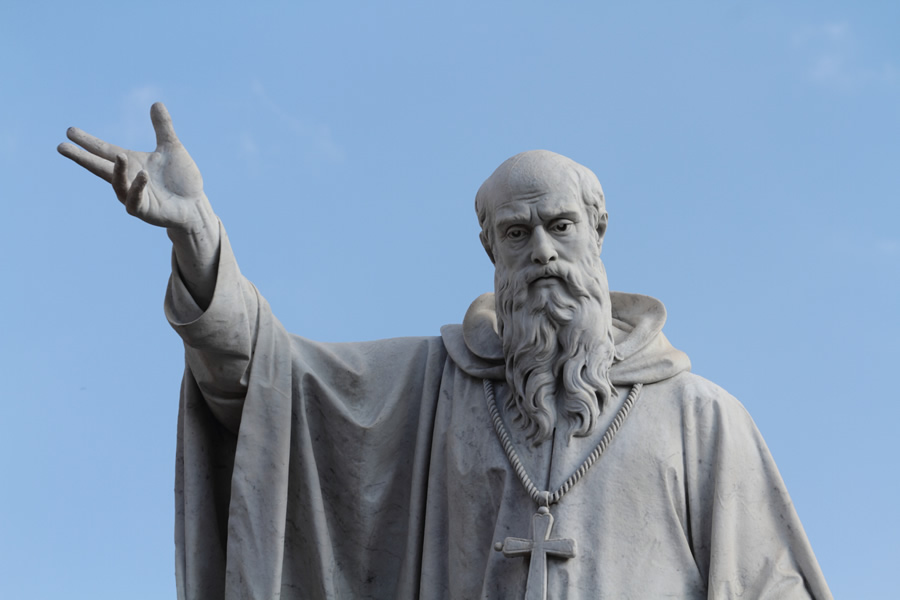
Recently, the Church celebrated the feast of Saint Benedict of Nursia, who refused to divide them.
A Rule Born in the Ruins
Benedict was born around the year 480, as the Roman world was collapsing around him. Sent to study in Rome, he saw the moral rot of the city up close and walked away from it, seeking God in solitude at Subiaco. In time, he founded the monastery of Monte Cassino and wrote a short guide for the life he had found there, called the Rule of St. Benedict.
His aim was modest: to order a single day around God. Yet the practices of that small project are still used today. For fifteen centuries, his Rule has been forming lives, and its central insight is one we can all benefit from.
Ora et Labora
The spirit of Benedict’s Rule is captured in three Latin words: ora et labora—pray and work. He refused to treat them as rivals competing for the same hours within a day. Prayer and work were two halves of one life offered to God, woven together in a daily rhythm: time to pray, time to labor, time to rest, and then to begin again.
For Benedict, the labor itself was holy—the hours at the workbench, the field, and the ledger were a way of seeking God, as long as each was done for Him. St. Paul had said it plainly: “Whatever you do, do from the heart, as for the Lord and not for others. (Col 3:23)” Benedict built an entire way of life on that one sentence.
Just like him, your company is part of your spiritual life—everything you do can be offered to God.
Benedict summarized the aim of his whole Rule with one line from Scripture: “In all things God may be glorified through Jesus Christ. (1 Pt 4:11)” In all things. Not only in the chapel, but in the office. Not only on Sunday, but also on Monday.
Build the Rhythm
There is a practical gift here. Benedict knew that good intentions collapse without structure, so he built prayer into the architecture of the day and gave it a fixed place rather than leaving it to the leftover minutes. You can do the same.
Choose the points in your day when you will turn to God—before the laptop opens, before a hard meeting, at the close of the workday—and let them hold, the way Benedict’s hours held for centuries. Holiness in business is a rhythm you keep.
But a daily rhythm needs a daily anchor. His Way At Work sends free Daily Reflections each morning—a short passage of Scripture and a brief meditation to begin the workday with God before the demands arrive. This is just one of many ways that you can commit time with the Lord.
You were never meant to live two lives. Offer both your prayer and work to God, and discover how they were never meant to be apart.