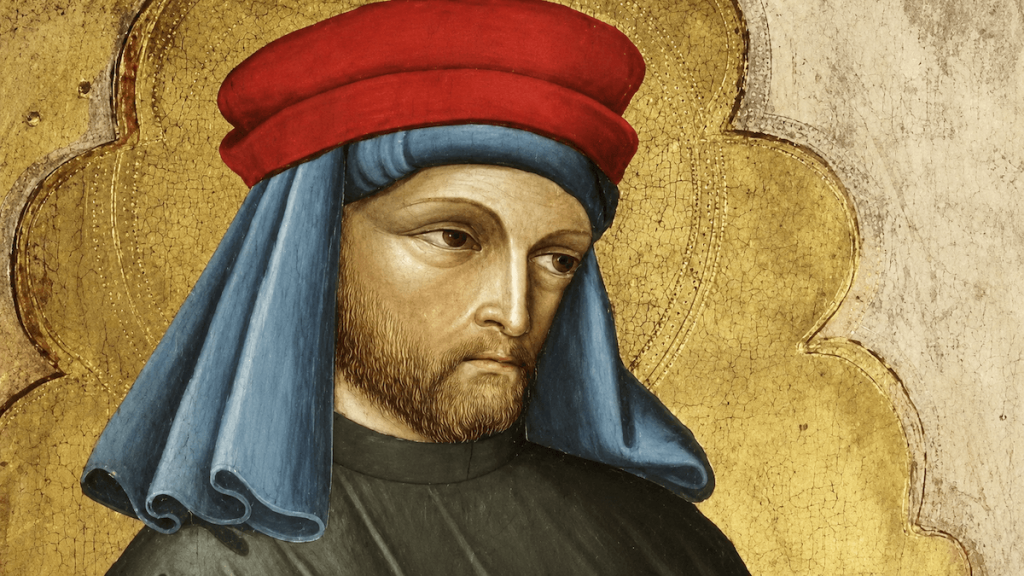
Catholic business owners live with a question that has no simple answer. How do you pursue growth, serve your customers, provide good jobs, and still keep God at the center? It can be tempting to treat faith as something that happens before work or after the day is finished. St. Homobonus offers a different vision. He shows us that holiness can be found in the marketplace itself.
Meet St. Homobonus, the merchant saint
Often described as the patron saint of business people, St. Homobonus was a cloth merchant in twelfth-century Cremona. His name comes from the Latin homo bonus, meaning “good man.” He became known not because he escaped ordinary work, but because he brought honesty, prayer, generosity, and peace into it.
Homobonus worked in the family cloth trade and was remembered as a merchant who resisted the dishonesty and bad faith around him. He treated his work as a place to practice justice. He cared for the poor, welcomed those in need, helped bury the abandoned dead, and used what he had to serve others. Pope Innocent III’s canonization decree described him as “a man good in name and deed.”
His spiritual life was not separate from his business life. He attended Mass and prayed regularly, and he died while attending Mass and contemplating the Crucifix. A little more than a year later, Pope Innocent III canonized him. His life remains a reminder that a layman can pursue holiness without leaving ordinary work behind.
Let your word be worth more than your margin
Homobonus’s first lesson for an owner is simple: integrity must reach the transaction. Your pricing, promises, timelines, product quality, and response to mistakes all teach people what your word is worth.
That may mean telling a customer when your company made an error, refusing to promise a delivery date you cannot meet, or recommending a solution that genuinely serves the customer even when it produces less revenue. Excellence and profitability matter, but they cannot be built on deception. A good name is not a marketing asset you manufacture. It is the reputation that grows when your character stands behind your work.
Treat profit as a tool for the common good
Homobonus did not treat prosperity as an excuse for comfort or self-importance. His example invites us to see profit as something to steward. A healthy business needs profit to survive, pay people fairly, improve its service, and continue serving its customers. But profit is a means, not the final measure of what the company is for.
Ask what your decisions make possible for the people entrusted to your leadership. Do your employees and their families have room to flourish? Are customers treated as people rather than targets? Does the success of the company make you more capable of serving the poor, strengthening your community, and creating something that will outlast you? These questions turn business excellence into an expression of love of neighbor.
Make prayer part of the operating rhythm
Homobonus’s work rested on prayer. He did not divide his life into a spiritual part and a business part. He brought his whole life before God, and that is the invitation he gives Catholic owners today.
Prayer does not replace planning, financial discipline, or good counsel. It purifies the reasons behind them. Begin the workday by offering the company to God. Bring a difficult hire, major investment, or strained relationship into prayer before reacting. When possible, take important decisions to Mass or to a trusted priest and ask for the freedom to choose what is truly good, not merely what is most profitable.
Holiness can be found in the marketplace
Homobonus was not holy in spite of being a merchant. He learned to pursue holiness through the way he worked, served, prayed, and treated people. That is why his example speaks so directly to Catholic business owners. A thriving business and a holy life were never meant to compete. Grace does not pull you out of your work. It meets you inside it and makes the work itself a path to God.
You do not have to imitate every detail of a twelfth-century merchant’s life. Start with one daily task. Whether that is to begin with a faithful decision in the company you are leading, telling the truth when it costs you margin, making one decision with the well-being of your employees in view, or bringing one unresolved business question honestly before God.
Ask St. Homobonus to pray for your business, and consider placing the company formally in God’s hands through consecration to the Sacred Heart. The goal is not to make your company look Catholic. It is to let your faith shape the way the company works, serves, and creates lasting value.